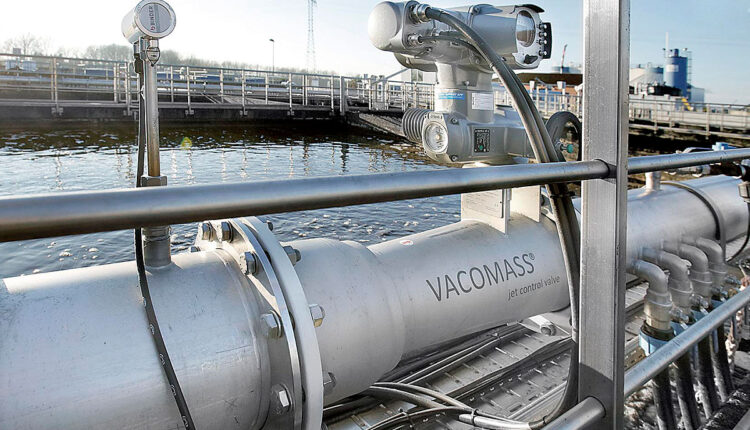
Binder VACOMASS® Jet: Turning Pressure Loss into Operational Excellence

Binder VACOMASS® Jet was developed to address one of the most underestimated sources of energy loss in wastewater treatment plants: pressure dissipation within aeration control valves.
In discussions about aeration efficiency, attention is typically directed toward blower performance, diffuser design, and advanced control strategies. However, a critical component often remains overlooked—the airflow control valve, despite being directly responsible for regulating every unit of air entering the biological process.
Each cubic meter of air must pass through this control element before reaching the aeration tanks. While relatively small in size compared to the overall system, its hydraulic behavior has a direct and continuous impact on energy demand, blower load, and total operating expenditure.
Conventional control valves were generally engineered for broad industrial gas or fluid applications, rather than the highly dynamic and efficiency-sensitive requirements of wastewater aeration systems. As a result, they frequently introduce unnecessary pressure losses, limited modulation precision, and inconsistent repeatability under varying operating conditions.
These limitations translate directly into increased blower energy consumption, as additional power is required to overcome internal resistance without delivering any corresponding improvement in process performance. In a sector where aeration can represent up to 70% of total plant energy consumption, even marginal inefficiencies in pressure management accumulate into significant lifecycle costs.
This is where Binder VACOMASS® Jet introduces a fundamentally different engineering approach—shifting the focus from conventional throttling to aerodynamic efficiency and pressure recovery, effectively redefining how airflow control contributes to overall system performance.
Why Pressure Loss Matters More Than Most Operators Realize
Pressure loss is frequently accepted as an unavoidable part of airflow control. However, from an engineering perspective, every millibar lost inside a valve represents energy that must be supplied by the blower.
Conventional control valves commonly operate with pressure drops ranging from 40 to 70 mbar. While these values may appear modest relative to overall system pressure, their cumulative impact on operating costs is far from insignificant. Over years of continuous operation, excessive pressure loss becomes a hidden energy drain that directly affects plant efficiency and lifecycle costs.
As Manuela Charatjan, Director Process Engineering at Binder Group, often emphasizes, pressure loss should never be viewed merely as a hydraulic parameter. It is an operational cost that wastewater utilities pay every day through increased blower energy demand.
Engineering evaluations have shown that reducing pressure loss by approximately 50 mbar in a system operating around 600 mbar can generate direct energy savings exceeding 8%, with total savings potentially reaching 15% depending on plant conditions and airflow demand.
This reality is changing the way progressive utilities evaluate aeration equipment. Instead of focusing exclusively on initial investment, they are increasingly considering the long-term economic impact of pressure losses throughout the life of the plant.
Introducing VACOMASS® Jet: Designed Around Pressure Recovery
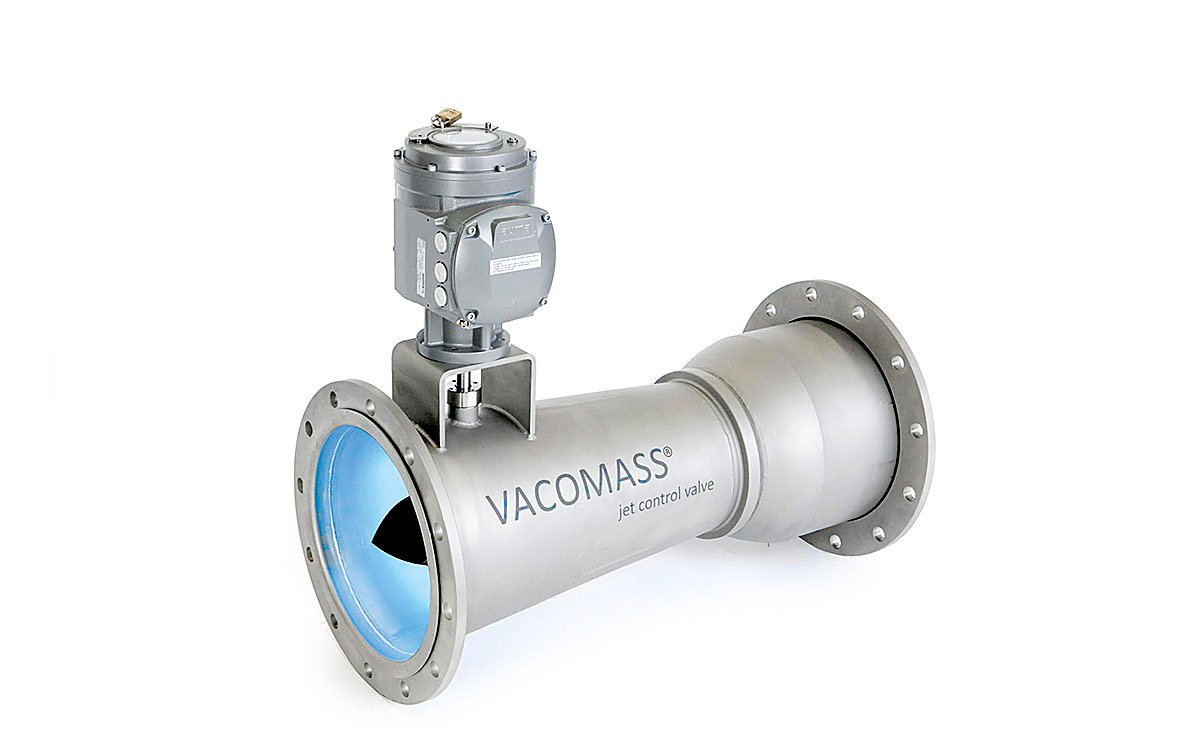
Recognizing the limitations of conventional valve technologies, Binder Group developed the VACOMASS® Jet Control Valve specifically for wastewater aeration applications.
Unlike traditional valves that simply throttle airflow, VACOMASS® Jet utilizes an advanced aerodynamic design based on pressure recovery principles. Inspired by airflow concepts used in aerospace engineering, the valve incorporates an integrated Venturi effect that allows a significant portion of pressure energy to be recovered downstream of the control element.
This innovation fundamentally changes the role of the control valve within an aeration system. Instead of acting as a source of pressure loss, the valve actively contributes to system efficiency.
One of the most remarkable features of VACOMASS® Jet is its ability to recover up to 75% of the pressure drop generated during airflow regulation. As a result, the valve operates with exceptionally low-pressure losses of only 2–5 mbar across its entire control range.
According to Manuela Charatjan, the objective of modern aeration control is not simply to regulate airflow. The real goal is to deliver the required oxygen transfer with the lowest possible energy input while maintaining process stability. This philosophy is at the core of the VACOMASS® technology platform and has guided its development from the beginning.
For wastewater treatment facilities facing increasing energy costs, the ability to dramatically reduce pressure losses can translate directly into lower operating expenses and improved sustainability performance.
Engineering Advantages Beyond Energy Savings
While pressure recovery is the headline feature of VACOMASS® Jet, its benefits extend well beyond energy efficiency alone.
The valve’s streamlined aerodynamic flow path minimizes turbulence and airflow disturbances, creating more stable and predictable operating conditions. Reduced turbulence not only improves airflow distribution but also decreases mechanical stress throughout the aeration system.
Key technical advantages include:
- Pressure loss of only 2–5 mbar throughout the control range.
- Up to 75% pressure recovery through integrated Venturi technology.
- Linear operating characteristics from fully closed to more than 95% stroke.
- Exceptional positioning accuracy and repeatability.
- Valve sizing often identical to pipe sizing, eliminating unnecessary reducers and expansions.
- Virtually maintenance-free operation apart from actuator servicing.
- Reduced blower loading and extended equipment life.
These characteristics allow operators to achieve precise airflow regulation while simultaneously lowering maintenance requirements and improving overall system reliability.
As Manuela Charatjan notes, the most effective aeration valve is not simply the one that controls airflow—it is the one that controls airflow while minimizing pressure loss and reducing lifecycle costs. This principle explains why pressure recovery technology has become increasingly important in modern wastewater treatment design.
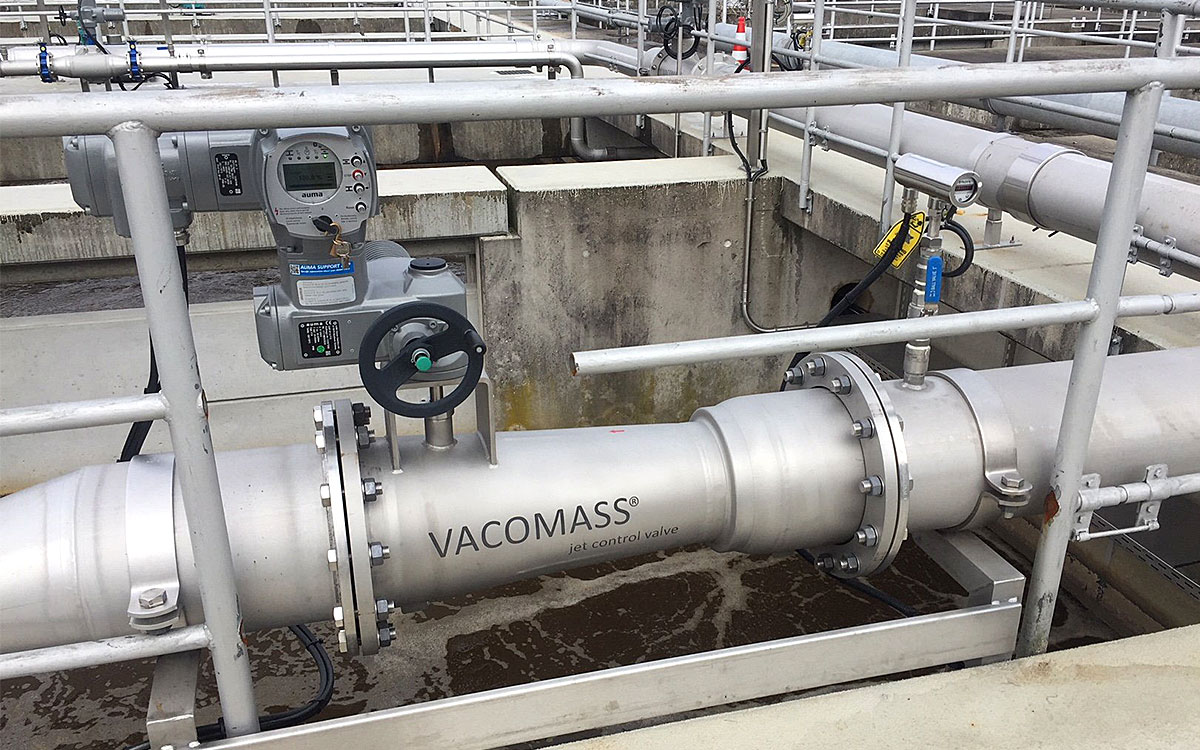
Lower OPEX and a Smaller Carbon Footprint
Today, sustainability and economic performance are closely linked. Every kilowatt-hour saved reduces both operating costs and greenhouse gas emissions.
Because VACOMASS® Jet dramatically minimizes pressure losses, blowers require less energy to deliver the same volume of air to the biological process. This reduction in power demand can generate substantial savings over the lifespan of a treatment plant.
Beyond financial benefits, lower energy consumption directly contributes to a reduced carbon footprint. For utilities pursuing sustainability targets and environmental commitments, technologies that improve energy efficiency offer value that extends beyond simple cost reduction.
By combining low pressure loss, high control accuracy, and exceptional reliability, VACOMASS® Jet enables operators to achieve both operational and environmental objectives without compromising treatment performance.

A Technology Trusted Worldwide
VACOMASS® technologies have been successfully implemented in wastewater treatment facilities across Europe, Asia, North America, and Oceania. Installations can be found in Germany, the Netherlands, Austria, Singapore, China, New Zealand, and the United States, among many other regions.
These projects range from medium-sized municipal facilities to some of the largest wastewater treatment plants in the world. Their continued adoption reflects growing industry recognition that airflow control devices play a critical role in determining overall aeration efficiency.
The global success of VACOMASS® demonstrates that improving aeration performance is not solely about larger blowers or more sophisticated automation systems. It is equally about optimizing every component through which air flows.
Conclusion
For many years, control valves were viewed simply as devices for regulating airflow. VACOMASS® Jet challenges that perception by demonstrating how intelligent engineering can transform a traditionally overlooked component into a powerful tool for energy optimization.
Through its unique pressure recovery technology, ultra-low pressure losses, exceptional control precision, and long-term reliability, VACOMASS® Jet helps wastewater treatment facilities reduce operating costs while improving overall process performance.
As utilities continue to pursue greater efficiency, sustainability, and resilience, the future of aeration optimization will depend not only on how air is produced, but also on how efficiently it is controlled.
In that future, the control valve is no longer just part of the aeration system—it is part of the solution.

