
How Next Turbo Blowers Are Redefining Aeration Efficiency in Middle East WWTPs

Selecting the appropriate blower technology is a critical decision in wastewater treatment plants, as it directly affects energy efficiency, operational flexibility, and lifecycle cost. Different blower technologies exist, each with its own operating principle and performance characteristics.
Wastewater treatment plants in the Middle East often operate under challenging environmental conditions, including high ambient temperatures, fluctuating electricity quality, and varying process loads. Under such conditions, equipment reliability, electrical stability, and energy efficiency become critical design priorities.
The constant-speed centrifugal blower concept used by Next Turbo Technologies provides several advantages in these environments, including stable operation, reduced sensitivity to electrical harmonics, and improved efficiency across varying operating conditions.
Overview of Common Blower Types
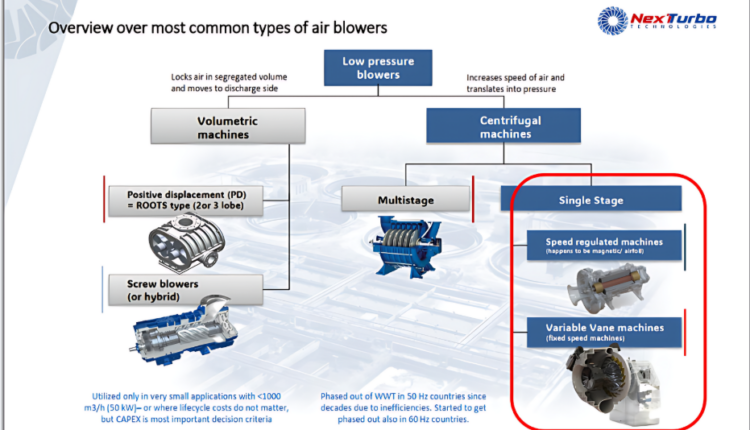
Air blowers used in wastewater treatment plants can generally be categorized into two main groups: volumetric machines and centrifugal machines.
Volumetric machines include technologies such as positive displacement (PD) blowers, commonly known as Roots blowers, which operate by trapping air in a defined volume and transporting it from the inlet to the discharge side. This design relies on moving a fixed volume of air with each rotation. On the other hand, centrifugal machines work by increasing the speed of air and converting this speed into pressure. These machines include several configurations such as single-stage centrifugal blowers, multistage blowers, and screw blowers.
Efficiency Advantages of Single-Stage Centrifugal Blowers
Among centrifugal technologies, single-stage centrifugal blowers have become an attractive solution for modern wastewater treatment plants due to their efficiency and operational flexibility. The efficiency of a blower system is strongly influenced by the way airflow is regulated to match the process demand. While many systems rely on speed control using a variable frequency drive (VFD), this approach is not always the most efficient solution for centrifugal machines. Instead, systems using dual modulating vane control can achieve higher efficiency across the operating range.
According to efficiency comparisons:
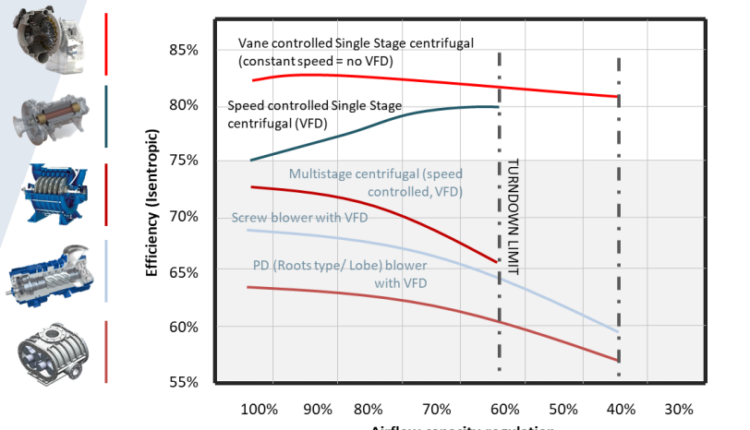
- Dual modulating vane control systems typically achieve 80–84% efficiency.
- Speed control systems using VFD usually operate within 70–84% efficiency.
This represents an average efficiency advantage of approximately 8–10 percentage points when using modulating vane control instead of simple speed control. In addition, when comparing centrifugal blowers with Roots (PD) blowers, centrifugal technologies demonstrate superior efficiency across a wider operating range, making them better suited for modern wastewater treatment processes where airflow demand fluctuates significantly. One of the companies that has specialized in advancing single-stage centrifugal blower technology is Next Turbo Technologies.
Next Turbo blowers are designed based on a constant-speed concept combined with advanced dual modulating vane control. This design philosophy allows the blower to achieve high efficiency while avoiding many of the limitations associated with variable-speed control.00
Florian Adam,
Sales Director and Member of the Board at Next Turbo Technologies
How to Design a Centrifugal Air Blower That Can Regulate Airflow
A key challenge in blower design is the ability to regulate airflow efficiently while maintaining stable pressure.
Speed Control Using VFD
One common method is regulating airflow by changing the rotational speed of the blower using a variable frequency drive (VFD). With this approach:
- Airflow varies proportionally with the rotational speed.
- Pressure varies proportionally with the square of the speed.
However, this solution requires the blower to be designed for a higher pressure than normally needed in order to maintain control capability. As a result, the blower often operates below optimal efficiency. In addition, this method usually allows airflow regulation only within a range of 75% to 100% of capacity.
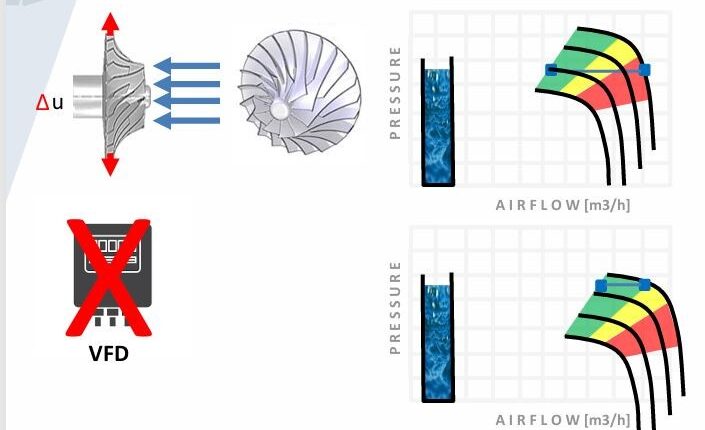
When operating close to the lower flow range, the blower may also approach the surge limit, which can lead to unstable operation, vibration, and increased noise levels. Continuous operation near this condition may negatively affect reliability and mechanical components over time.
Modulating Vane Control
An alternative approach is modulating vane control, where airflow is regulated through variable diffuser vanes and inlet guide vanes rather than by changing the speed of the blower. In this design:
- The blower operates at a constant speed.
- No VFD is required.
- No harmonic distortion (THD) is introduced to the electrical network.
- Airflow is regulated without affecting the pressure drop in the system.
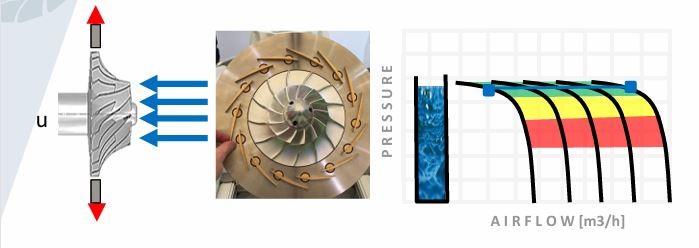
This design principle is implemented in Next Turbo single-stage centrifugal blowers, where airflow is regulated using advanced vane control instead of relying solely on speed variation.
Dual Modulating Vane Control
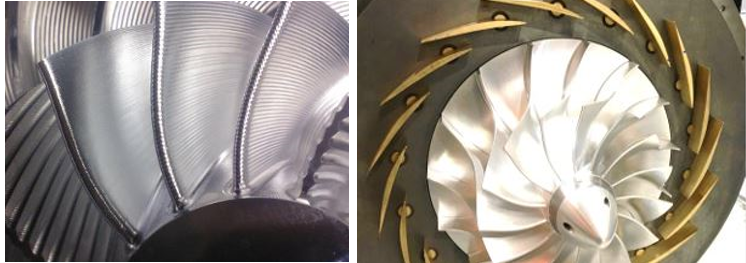
Constant-speed blower design is further improved by implementing dual modulating vane control, which combines:
- Variable diffuser vanes
- Inlet guide vanes
This configuration allows the blower to optimize performance when external conditions change, such as:
- Fluctuations in suction air temperature
- Changes in barometric pressure
- Variations in system pressure
This approach improves operational stability and efficiency across the full regulation range.
Conclusion
Selecting the right blower technology plays a crucial role in determining the energy efficiency, operational stability, and long-term cost of wastewater treatment plants. While traditional blower systems often rely on variable-speed control using VFDs, this approach may introduce operational limitations such as surge risk and electrical harmonic distortion. The constant-speed centrifugal blower design with dual modulating vane control offers a more stable and efficient alternative. By combining advanced aerodynamic design with intelligent airflow regulation, Next Turbo Technologies provides a blower solution that delivers high efficiency, wide operational flexibility, and reliable performance — making it particularly well suited for modern wastewater treatment plants in the Middle East.

