
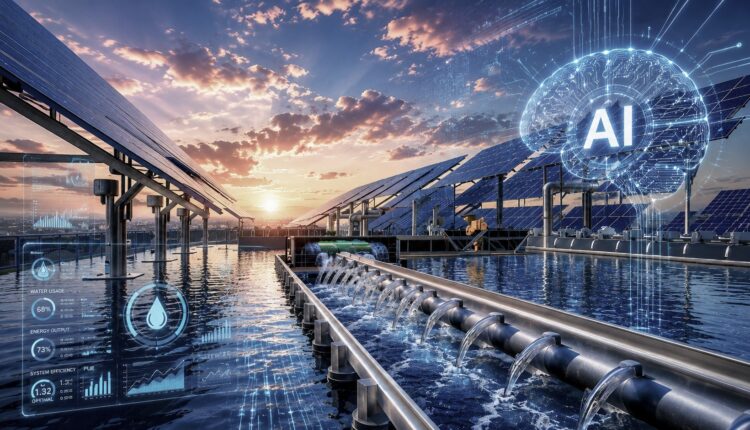

Artificial intelligence is transforming industries at an unprecedented pace, driving innovation in healthcare, finance, manufacturing, and infrastructure. Behind this digital revolution lies a rapidly expanding network of AI data centers that require enormous computational power. However, the energy demand of these facilities is only part of the story. Cooling high-performance processors generates massive heat loads, making water a critical resource in data center operations. As AI infrastructure scales globally, the water footprint of data centers is becoming an increasingly important environmental concern. Effective water management strategies are now essential to ensure technological advancement does not come at the expense of water sustainability.
The Rising Thermal Demand of AI Infrastructure
The rapid growth of artificial intelligence has significantly changed the architecture and operating requirements of modern data centers. Traditional computing facilities were designed around CPUs with moderate power requirements, but AI workloads depend heavily on GPUs that consume far more energy.
A standard CPU may require 150–200 watts, while advanced AI GPUs can consume more than 1,200 watts each. When thousands of these processors operate simultaneously, rack power densities rise dramatically. This increase in computational intensity creates extreme thermal loads. Managing such concentrated heat using conventional air cooling becomes inefficient and impractical. As AI infrastructure continues expanding, thermal management is becoming one of the most critical engineering challenges. Cooling systems must evolve to handle higher heat densities while maintaining efficiency, reliability, & environmental responsibility.
Why Water Matters in AI Cooling?
Water plays a central role in cooling AI data centers because of its superior thermal properties. Compared with air, water can absorb and transport far more heat per unit volume, making it significantly more effective for high-density cooling applications. This makes water-based cooling systems ideal for facilities processing AI workloads around the clock. Direct-to-chip liquid and immersion cooling are increasingly replacing traditional air-cooling systems. In these methods, liquids absorb heat directly from computing hardware, enabling faster, more efficient heat removal. Water’s high specific heat capacity and thermal conductivity enable cooling systems to maintain stable temperatures even under extreme loads. As AI servers become more powerful, reliance on water-based cooling will likely increase. This makes efficient water use and recycling crucial for long-term sustainability in the digital economy.
The Water-Energy Nexus in Data Centers
Water and energy are deeply interconnected in data center operations. Cooling systems designed to reduce water consumption often require more electricity, while energy-efficient systems may consume more water. This creates a complex engineering trade-off between power usage effectiveness (PUE) and water usage effectiveness (WUE). Closed-loop chiller systems, for example, minimize direct water consumption by recirculating water within a controlled system. However, these systems require large amounts of electricity to operate compressors & chillers. On the other hand, evaporative cooling systems consume more water but can significantly reduce energy use by leveraging the natural cooling effect of evaporation. Finding the optimal balance between water & energy efficiency is essential. Operators must evaluate local climate conditions, water availability, & electricity sources to design sustainable cooling strategies.
Pressure on Local Water Resources
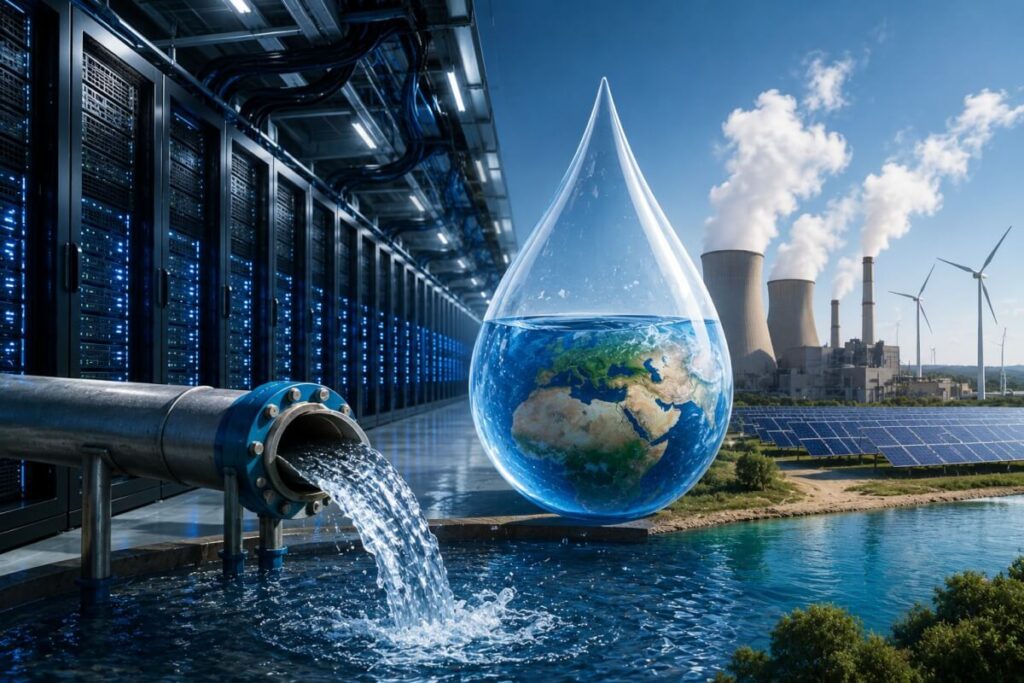
The expansion of AI data centers is increasing pressure on municipal and regional water supplies. Large-scale facilities can consume millions of liters of water each day, especially when using evaporative cooling technologies. In water-stressed regions, this demand can create tension between industrial growth and community needs. A single large AI data center can consume water equivalent to thousands of households. This becomes especially concerning in regions already facing drought, groundwater depletion, or climate-related water scarcity. Communities are increasingly scrutinizing large data infrastructure projects due to concerns over water access and environmental impact. As a result, water-sourcing strategies are becoming as important as cooling technologies themselves. Sustainable growth requires careful planning to ensure data centers do not compromise local water security.

Challenges of Blowdown and Brine Management
Cooling towers improve thermal efficiency but introduce another major challenge: blowdown management. As water evaporates during cooling, dissolved minerals such as calcium, silica, and salts remain behind, increasing concentration levels within the system. If not controlled, these contaminants can cause scaling, corrosion, and biofouling. To prevent operational damage, facilities periodically discharge concentrated water through a process called blowdown. While necessary, this creates wastewater containing high concentrations of dissolved solids. Managing this brine stream presents both economic and environmental challenges.
Disposal costs vary depending on regulations and location. Stricter environmental policies often limit discharge options, pushing operators toward more advanced treatment solutions. Effective brine management is therefore essential for maintaining both operational performance and regulatory compliance.
Advanced Water Treatment Technologies
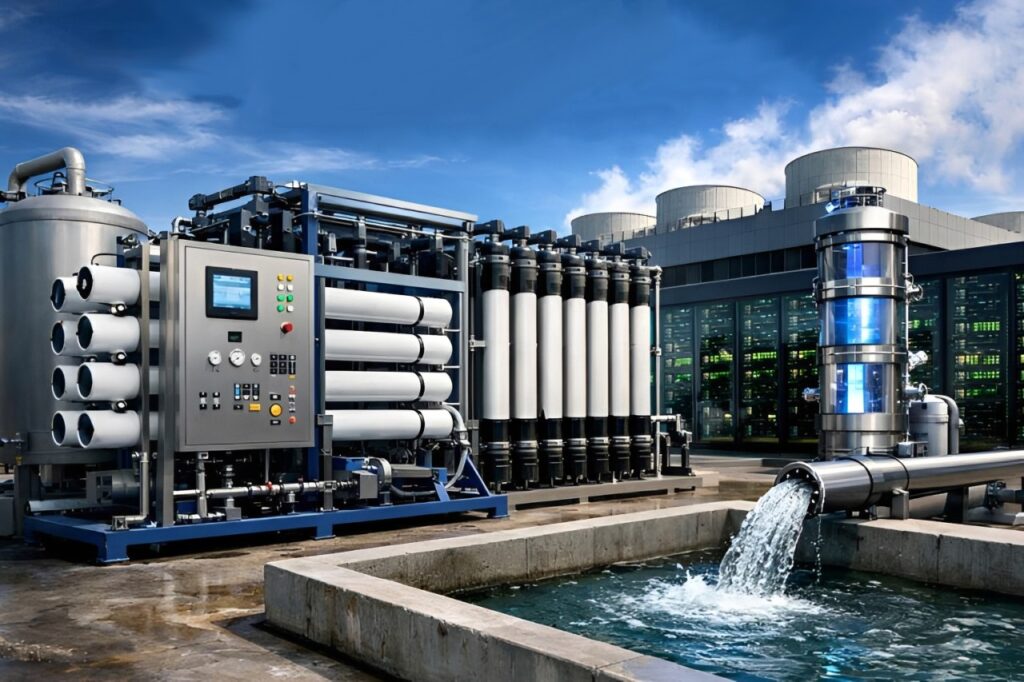
Modern water treatment technologies are enabling AI data centers to reduce freshwater consumption while improving cooling reliability. Reverse osmosis (RO), filtration systems, and advanced membrane technologies help recover usable water from wastewater streams and reduce blowdown volumes. High-recovery membrane systems can extract more clean water from challenging feed streams, including brackish groundwater and industrial wastewater. Pretreatment processes such as softening, biological control, and chemical dosing help protect membranes from fouling and scaling. Innovations in desalting and concentration management are also improving water recovery rates. Some facilities are moving toward near-zero liquid discharge systems, where almost all water is reused internally. These technologies reduce dependence on municipal water supplies while minimizing environmental discharge. For AI facilities, integrating advanced water treatment is becoming a strategic necessity rather than an optional sustainability measure.
Alternative Water Sources for Sustainable Cooling
To reduce stress on potable water supplies, many data centers are exploring alternative water sources. Instead of relying solely on municipal drinking water, operators are increasingly using reclaimed wastewater, industrial greywater, and brackish groundwater for cooling purposes. Recycled water offers significant sustainability benefits by converting waste streams into valuable cooling resources. However, these alternative sources often contain higher concentrations of dissolved solids, organics, and biological contaminants. This requires robust pretreatment and monitoring systems. Using non-potable water for cooling helps preserve drinking water for communities while improving circular water use. In regions facing water scarcity, alternative sourcing may become a requirement for future data center development. The shift toward water reuse represents a major step in sustainable AI infrastructure planning.

The Future of Sustainable AI Data Centers
As AI continues to reshape global economies, data center design must evolve beyond traditional performance metrics. Future facilities will need to optimize computational output, energy efficiency, and water stewardship simultaneously. Sustainability is no longer a secondary consideration—it is a core engineering requirement.
Digital monitoring systems, AI-driven predictive maintenance, and smart water analytics will help operators improve efficiency in real time. Sensors can detect leaks, optimize cooling cycles, and identify scaling risks before failures occur. This data-driven approach enables more precise resource management. The next generation of AI data centers will likely combine advanced cooling, water recycling, and intelligent automation. Facilities that successfully integrate these systems will be better positioned to meet growing demand while minimizing environmental impact.
Conclusion
The growth of AI presents extraordinary opportunities, but it also introduces significant infrastructure challenges—particularly in water management. As computing power increases, so does the need for advanced cooling systems capable of handling extreme thermal loads efficiently. Water has emerged as one of the most valuable resources in this equation. Sustainable AI development depends on balancing innovation with responsible resource management. Through advanced cooling methods, alternative water sourcing, wastewater recovery, and intelligent monitoring, data centers can dramatically reduce their environmental footprint. The future of AI should not be defined solely by processing power but also by how responsibly we manage the natural resources that make digital progress possible.
Discover More: https://mg.aquaenergyexpo.com/issue/

